Blog
How to Choose the Right Machine Embroidery Design for Different Fabric Types

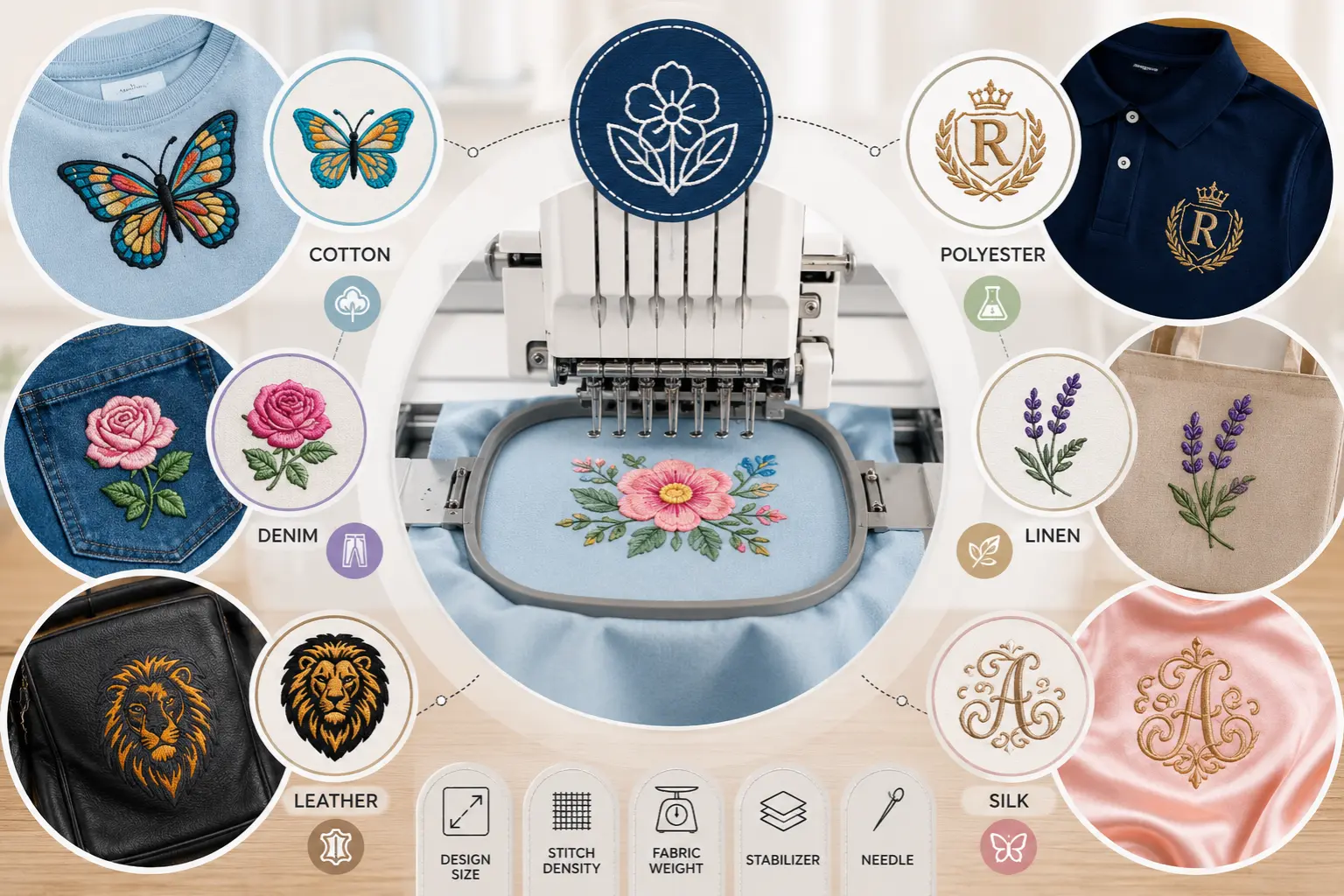
Choosing the right machine embroidery design is one of the most important decisions in achieving high-quality embroidery results. Many people assume that any design can be stitched on any fabric as long as the machine is set correctly. However, in reality, fabric type plays a major role in how an embroidery design performs, looks, and holds up over time.
A design that looks crisp on a stable denim jacket may completely distort on a stretchy polo shirt. A dense logo that works perfectly on canvas may cause puckering on lightweight cotton. Even small differences in fabric behavior can significantly affect stitch quality, design clarity, and garment durability.
This is why understanding how to match embroidery designs with fabric types is essential for digitizers, embroidery businesses, and apparel brands.
In this guide, we will explore how to choose the right machine embroidery design for different fabric types and how professional digitizing adjustments ensure perfect results across all materials.
Why Fabric Type Matters in Machine Embroidery
Fabric is not just a surface—it is an active part of the embroidery process.
Each fabric behaves differently when stitches are applied:
- Some fabrics stretch
- Some resist needle penetration
- Some absorb stitches deeply
- Some shift under tension
When embroidery is applied, the interaction between thread and fabric determines the final appearance.
Without proper design selection and digitizing adjustments, even high-quality embroidery machines cannot prevent issues such as:
- Distortion
- Puckering
- Misalignment
- Thread breakage
- Poor readability
This is why professional embroidery always begins with understanding fabric behavior.
Key Factors That Affect Embroidery Design Selection
Before choosing a design, it is important to evaluate the following factors:
1. Fabric Stability
Stable fabrics hold stitches well without stretching or shifting.
Examples:
- Denim
- Canvas
- Twill
- Felt
Unstable fabrics:
- Jersey
- Spandex
- Lightweight cotton
- Knits
Stable fabrics can handle more detailed and dense designs, while unstable fabrics require simplified and lighter embroidery.
2. Fabric Thickness
Thicker fabrics support heavier stitching.
Examples:
- Jackets
- Hoodies
- Upholstery fabric
Thin fabrics require careful control to avoid visible stitch impressions or damage.
3. Stretchability
Stretchable fabrics require special attention because embroidery does not stretch the same way.
If not adjusted properly, embroidery can:
- Crack
- Distort
- Pull the fabric out of shape
4. Texture and Surface Type
Different surfaces affect stitch visibility and stability.
Examples:
- Smooth (polos, shirts)
- Rough (towels, fleece)
- Structured (caps, hats)
Each surface requires different embroidery design considerations.
Choosing the Right Embroidery Design for Common Fabric Types
1. Cotton Fabrics
Cotton is one of the most commonly used fabrics in embroidery.
Best Design Types:
- Medium-density designs
- Clean logos
- Satin stitch lettering
- Light to moderate fill patterns
Why:
Cotton is stable but can still wrinkle if overstressed.
Avoid:
- Extremely dense fills
- Overly complex gradients
- Tiny lettering
Best Practice:
Use balanced stitch density and proper underlay to prevent puckering.
2. Polyester Fabrics
Polyester is widely used in sportswear and uniforms.
Best Design Types:
- Lightweight embroidery designs
- Clean vector-based logos
- Minimal fill density
Why:
Polyester is slightly stretchable and heat-sensitive.
Avoid:
- Heavy stitch coverage
- High-density fills
- Large solid areas
Best Practice:
Use controlled stitch density and proper compensation to prevent distortion.
3. Stretch Fabrics (Spandex, Lycra, Jersey)
Stretch fabrics are the most challenging for embroidery.
Best Design Types:
- Simple logos
- Minimal details
- Light stitch coverage
Why:
These fabrics stretch during wear and embroidery.
Avoid:
- Dense fills
- Small text
- Thin lines
Best Practice:
Use high-quality stabilizers and reduced stitch density to maintain flexibility.
4. Denim and Heavy Fabrics
Denim is strong and stable, making it ideal for embroidery.
Best Design Types:
- Bold logos
- High-density fills
- Detailed artwork
- Large designs
Why:
Denim supports heavy stitching without distortion.
Avoid:
- Extremely fine details that may get lost in texture
Best Practice:
Use strong underlay and higher density for bold visual impact.
5. Caps and Hats
Caps require specialized embroidery techniques due to their curved structure.
Best Design Types:
- Compact logos
- Curved-aware designs
- Simplified shapes
Why:
Curved surfaces affect stitch alignment and tension.
Avoid:
- Wide designs
- Small intricate text
- Flat-style layouts
Best Practice:
Use cap-specific digitizing with proper curvature compensation.
6. Towels and Terry Cloth
Towels are highly textured and absorbent.
Best Design Types:
- Bold lettering
- Thick outlines
- Simple shapes
Why:
The fabric texture can swallow small stitches.
Avoid:
- Thin lines
- Small text
- Fine details
Best Practice:
Use high stitch density and elevated underlay for visibility.
7. Fleece and Hoodies
Fleece is soft, thick, and plush.
Best Design Types:
- Medium to large designs
- Bold lettering
- Simple logos
Why:
Soft texture can hide fine details.
Avoid:
- Thin fonts
- Complex gradients
- Small logos
Best Practice:
Use stronger underlay to stabilize the surface before stitching.
How Digitizing Adjustments Improve Design-Fabric Matching
Even the best design must be adjusted through professional digitizing.
Key adjustments include:
Stitch Density Optimization
Each fabric requires a different density level.
- Too high → puckering and stiffness
- Too low → poor coverage
Underlay Strategy
Underlay stabilizes fabric before top stitching.
Different fabrics require:
- Edge walk
- Zig-zag underlay
- Double underlay for unstable fabrics
Pull Compensation
Prevents shape distortion caused by thread tension.
Stitch Direction Control
Enhances appearance and reduces fabric stress.
Design Simplification
Some fabrics require removing unnecessary detail for clarity.
Common Mistakes When Choosing Embroidery Designs
1. Using the Same Design for All Fabrics
This leads to inconsistent results.
2. Ignoring Fabric Stretch
Stretch fabrics require special design adjustments.
3. Overcomplicating Small Logos
Tiny details often disappear after stitching.
4. Using Excessive Density
More stitches do not always mean better quality.
5. Skipping Professional Digitizing
Even a perfect design will fail without proper digitizing.
How to Ensure Perfect Embroidery Results Every Time
To achieve consistent high-quality embroidery:
- Match design complexity to fabric type
- Use fabric-specific digitizing settings
- Test stitch samples before bulk production
- Avoid overly detailed artwork for unstable fabrics
- Work with professional digitizers
Final Thoughts
Choosing the right machine embroidery design for different fabric types is not just a design decision—it is a technical requirement for achieving professional results.
Each fabric behaves differently, and understanding these behaviors allows you to select designs that stitch cleanly, look sharp, and maintain durability over time.
When combined with expert embroidery digitizing, the right design selection ensures:
- Clean stitch quality
- Reduced production issues
- Better garment durability
- More professional branding
- Higher customer satisfaction
In embroidery, success is not just about the design itself, but how well it works with the fabric it is stitched on.
Get Expert Embroidery Digitizing for Perfect Fabric Matching
At Digitizing Logo, we specialize in professional embroidery digitizing tailored to all fabric types. Our expert digitizers ensure every design is optimized for cotton, polyester, caps, jackets, towels, stretch fabrics, and more.
Why Choose Digitizing Logo?
✔ Fabric-Specific Digitizing
✔ Clean and Production-Ready Stitch Files
✔ Fast Turnaround Times
✔ Optimized for Stitch Quality & Efficiency
✔ Support for All Embroidery Machine Formats
✔ Affordable Professional Services
Want Perfect Embroidery Every Time?
Send your artwork to Digitizing Logo today and get professionally digitized files that are optimized for your exact fabric type. Achieve cleaner stitches, fewer production issues, and premium embroidery results every time.